Tuesday, January 10

FTC takes aim at non-compete agreements

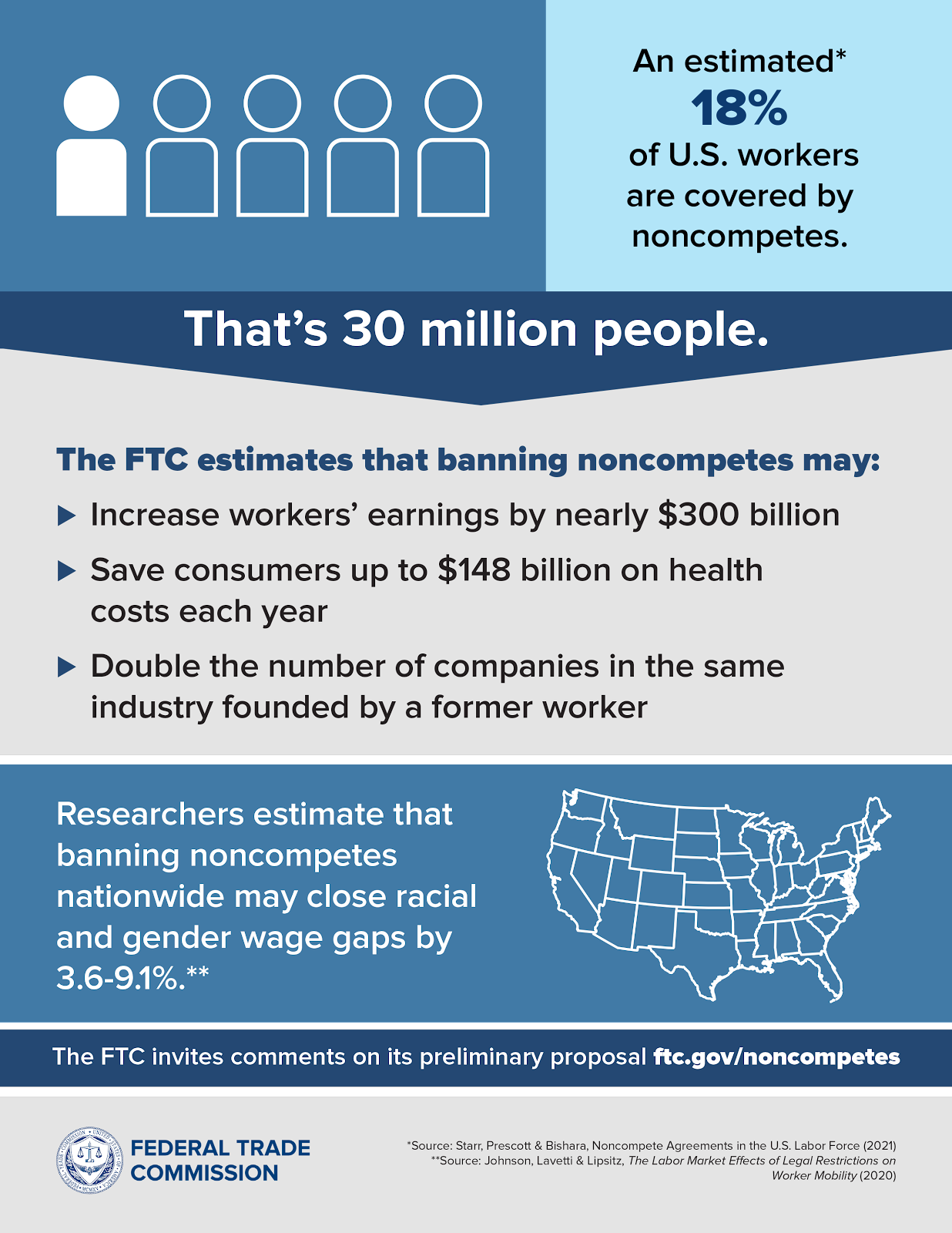
The Federal Trade Commission is proposing a new rule that would ban non-compete agreements because they suppress wages, hampers innovation and block entrepeneurs from starting new businesses. This is great news for workers.

For many years, I have represented workers who have been coerced into signing non-compete agreements that have stifled their ability to make a living. These agreements prevent workers from exercising their right to change jobs for more pay or better conditions. It is a terribly unfair burden to place on employees and gives employers far too much power over its employees, both current and former.

As proposed, the new rule would make it illegal for an employer to:

  • enter into or attempt to enter into a noncompete with a worker;
  • maintain a noncompete with a worker; or
  • represent to a worker, under certain circumstances, that the worker is subject to a noncompete.

The proposed rule would apply to independent contractors and anyone who works for an employer, whether paid or unpaid. It would also require employers to rescind existing noncompetes and actively inform workers that they are no longer in effect.

This last part - requiring that existing noncompetes be rescinded - could impact millions of workers.


The new rule is subject to public comments through March 10, 2023.

https://www.ftc.gov/news-events/news/press-releases/2023/01/ftc-proposes-rule-ban-noncompete-clauses-which-hurt-workers-harm-competition

Friday, June 1

Supreme Court slashes workers' rights

On May 21, 2018, the U.S. Supreme Court released decisions in three cases which take away workers' rights to band together to fight employers' wrongful acts.  Epic Sys. Corp. v. Lewis, 138 S. Ct. 1612 (2018)(single decision issued collectively with Ernst & Young LLP v. Morris and NLRB v. Murphy Oil USA, Inc.).

The decision, authored by Justice Gorsuch for the majority, means employees who are bound by arbitration agreements which ban collective action as a condition of employment are not allowed to join class-action lawsuits or group arbitration proceedings. 

The decision impacts tens of thousands of nonunion employees who, as a condition of employment, are required to waive their rights to join a class action suit. In all three cases, employees tried to sue collectively, arguing that the amounts they could obtain in individual lawsuits were dwarfed by the legal fees they would have to pay as individuals to bring their cases under the private arbitration procedures required by the company. For instance, the lead plaintiff for the Ernst & Young employees who sought to bring a class action had a case in arbitration that cost $200,000 in legal fees, although the possible recovery for unpaid overtime was only $1,800 to the individual. 

The employees contended that their right to collective action is guaranteed by the National Labor Relations Act. The employers countered that they are entitled to ban collective legal action under the Federal Arbitration Act. Under this decision, the FAA's protection of arbitration overcomes the NLRA's protection of collective action by employees. 

Bottom line:  This decision will likely mean that many federal and state wage and hour violations, and other workers' rights claims will go largely unenforced because the cost to enforce them in individual arbitrations will far outweigh the potential recovery for any one individual. It also means that the outcome of such cases will remain secret because arbitration, unlike the public court system, is private. 

Friday, March 9

JC Penney Sued for False Advertising in California

This week, my firm, along with Baker Law PC, filed another class action lawsuit against JC Penney for false advertising and deceptive trade practices. The case parallels the ongoing litigation against JC Penney in Alabama, which I've written about before.

The lawsuit seeks relief under Cal. Bus. & Prof. Code §§ 17200 and 17500 for JC Penney’s false advertising regarding the sale of jewelry, whether it involves metal fineness; the use of undisclosed or less-desirable metals as plating or finishes over precious metals; the existence, thickness or quality of metal plating; the use of alternative, cheaper, less-desirable, or non-precious metals or metal alloys; the number, size or quality of diamonds or other stones; the geographic origin of the item or its contents; failure to comply with the FTC Guides for the Jewelry, Precious Metals, and Pewter Industries; or any other characteristic of jewelry about which JC Penney has lied to make a sale. You can read the complaint here.

We are actively pursuing similar claims against JC Penney and other jewelry sellers for false advertising. Feel free to give me a call if you have concerns about whether you have purchased jewelry that was falsely advertised.

~bjm

Monday, January 9

More Evidence of False Advertising in the Jewelry Industry is Uncovered

After months of reviewing tens of thousands of internal J.C. Penney documents, our firm's class action lawsuit against J.C. Penney has uncovered evidence that we believe proves that hundreds of items of jewelry may have been falsely advertised over the past several years. My firm, Miano Law PC, has partnered with Baker Law PC in this litigation, which seeks to certify a class action on behalf of those who have been misled by false and deceptive jewelry advertising. The company, of course, denies that it has done anything wrong.

We have identified hundreds of items of jewelry sold by J.C. Penney which contain Rhodium plating, even though we have found very few advertisements which disclose the use of Rhodium plating. The items include virtually all kinds of jewelry, from rings to bracelets to necklaces to earrings. Most of the advertisements, including the one for the bracelet purchased by our client, claim that the plating is Platinum. Surprisingly, some items advertised as yellow or white Gold do not mention any plating at all, and yet internal records of J.C. Penney show that some of these items are actually plated with Rhodium. As I mentioned in my last post about this case, the failure to disclose the use of Rhodium plating is deceptive, in our view, and we hope to convince J.C. Penney to change these deceptive practices. It simply is not truthful to advertise a ring as white Gold if it is actually plated in Rhodium to make it shine more brightly.

We have also identified hundreds of items that we believe violate the FTC's standards for advertising the size of diamonds used in jewelry. These standards, which you can read for yourself here, require that retailers who advertise diamonds using fractions rather than more precise decimals explain in a "conspicuous" and nearby disclosure that the size is "not exact". The FTC standards also require that the advertisement contain a ''disclosure of a reasonable range of weight for each fraction" on "every page" where the fractional representation is made so that consumers know exactly what they are buying. We have found evidence that J.C. Penney violated this guideline routinely in advertising many diamonds over the past four years, although they recently (several years into this litigation) seem to have begun following the FTC standard. Again, J.C. Penney denies any wrongdoing.

Among the other deceptive advertising we are investigating in this case:  the use of incorrect country of origin designations; improper disclosure of lab-created gemstones; the undisclosed use of hollow, or rolled, gold; misrepresentations regarding the number of diamonds in a particular item of jewelry; and misrepresentations regarding the use of plating. As we proceed to review documents and take more discovery, we are learning more on a weekly basis. At this point, we estimate the total sales of falsely advertised jewelry sold by J.C. Penney is in the millions of dollars.

We are actively seeking consumers who have purchased jewelry from J.C. Penney over the last four years to aid in this litigation, particularly consumers from California. If you would like to get involved or have any questions about an item of jewelry you purchased, give me a call or send an email. I will be glad to inspect your jewelry and discuss your rights with you.

~B
Wednesday, November 30

Would You Like Some Poison With That Apple Juice?

There is growing evidence that arsenic and lead levels in apple and grape juices sold in the U.S. are dangerously high. Arsenic is a known carcinogen, and both arsenic and lead have been linked to developmental problems. In recent studies, long term arsenic exposure was linked to poor scores in language, memory, and other brain functions, as well as diminished intelligence.

Bottom line:  this is not something you want to put in your body. The problem is, juice makers are denying a problem, and no one is disclosing the arsenic or lead levels on the labels so you can make an informed decision. That needs to change.

TV's Dr. Oz raised concerns about arsenic levels in apple juice back in September, and since then, Consumer Reports has done an extensive study of 88 products, finding numerous products that contain more lead or arsenic than the FDA allows in our drinking water. Check out the Consumer Reports' story and findings here. The fact that kids drink a lot of the juice being sold in this country is cause for even greater concern, particularly when long term health effects are considered.

I am currently investigating these cases, and actively seeking information from consumers regarding these poison-laced products. If you want to discuss your situation with me, please get in touch.

Sunday, August 7

All That Glitters is Not Gold

Sometimes, it's Rhodium.

It has been said, by a former Queen of England, I believe, that even "brass shines as fair to the ignorant as gold to the goldsmiths." But if you thought you were buying gold, you're not likely to be pleased to find out that it was really only brass with a nice shine.

In the competitive world of retail jewelry, shiny sells. And very few materials offer as much shine as Rhodium. So making jewelry shine - even gold, silver or platinum jewelry - sometimes means plating it with Rhodium. Unfortunately, much of this plating is a secret to consumers, as most retailers don't ever mention that the little gold or platinum ring you just purchased is actually plated in a metal you've likely never heard of. Most consumers find out when the Rhodium wears off and the jewelry loses its shine, or even changes color.

Wednesday, April 27

Nickled and Dimed to Death

Everyday Americans are about to be nickled and dimed to death, and no one seems to care.

Would you mind if AT&T over-charged you by $1.75 every month on your cell phone bill?

Or if your cable provider added an unidentified fee of $3.00 to every cable subscriber's bill without telling you?

How about if your employer started secretly deducting $5 bucks out of every Alabama fan's paycheck, just because your boss is an Auburn fan?

Or how about if your mortgage company or credit card issuer adds an extra day of interest to your debt every year?

Guess what? It doesn't matter if you mind or not, because the U.S. Supreme Court ruled today that your best weapon against corporate thievery like that - a class action - can be taken away from you in the fine print of every contract you sign, so long as it hides behind the skirt of an arbitration clause.

Monday, April 4

TransOcean Execs Get Safety Bonuses for "Best Year" Ever!

Greed and stupidity sometimes seem to know no bounds.

TransOcean Ltd. just announced millions of dollars in bonuses to its executives based on the company's improved safety record last year...when 11 people were killed in the BP disaster. Calling it the “the best year in safety performance in our company’s history," the company announced the bonuses in its annual proxy statement released nearly one year after the April 20 explosion and collapse of the rig, which gushed crude oil into the Gulf of Mexico for 86 days.

Transocean built and provided the workers for the Deepwater Horizon, nine of whom died in the explosion. The rig was leased by BP, which denied most executives bonuses in 2010 following the explosion and clean-up.

Monday, November 22

Is the Better Business Bureau Operating a Pay to Play Scam?

I recently handled an arbitration for a homeowner who was horribly mistreated by a local service company. As a result of their mishandling the cleaning of her house after a water leak in her kitchen, all of the flooring and drywall in the home had to be replaced. The company refused to pay for the damage they caused, so we filed a claim with the Better Business Bureau ("BBB") to arbitrate the dispute, just as her contract with the company required.

The good news? The arbitration was free. The bad news? The arbitration resulted in her getting only a fraction of her damages paid by this company. I guess you get what you pay for.

In fact, that seems to be the way the BBB does business these days, according to this disturbing report from ABC News.

Thursday, November 18

FTC Strikes Back at Pom Wonderful's End Run

FTC lawyers have filed a motion to dismiss POM Wonderful's pre-emptive suit against the FTC challenging what it says it is a new rule requiring pre-approval before a company can make health claims.

POM filed suit in September, just before the FTC brought an administrative complaint against POM alleging false advertising regarding the health benefits of POM's pomegranate-based products.

Friday, November 5

Would You Like a Class Action Ban With That Arbitration Clause?

Next Tuesday, the U.S. Supreme Court will hear argument in a very dangerous case for consumers: AT&T Mobility v. Concepcion. If a majority of the Supremes accept AT&T's argument, consumer class actions may be effectively wiped out as a way to combat corporate deception against individuals.

A decision in favor of AT&T would be as damaging to the rights of individual Americans as if the Court upheld a ban on individual ownership of guns. For all the folks who believe that individual gun ownership is an essential protection against an out of control government, know that the class action mechanism is an equally essential protection against the tyranny of an out of control corporate oligarchy. Without it, consumers and employees simply have no weapons with which to fight back.

Monday, October 18

Pom Not So Wonderful?

It's an ironic twist that Pom Wonderful, which once sued a competitor for misrepresenting its product, is now the target of an FTC administrative complaint for...you guessed it -- making false claims about its products. Sad, but true.

The Federal Trade Commission has issued an administrative complaint charging the makers of POM Wonderful 100% Pomegranate Juice and POMx supplements with making false and unsubstantiated claims that their products will prevent or treat heart disease, prostate cancer, and erectile dysfunction.

Thursday, October 7

It's Not Easy Being Green

With apologies to Kermit, it might be getting a little easier to be "green".

The FTC has proposed new Green Guides on marketers' use of environmental claims, intended to clarify the existing Guides and make them easier for companies to follow. In particular, the FTC is concerned about the gap between what companies think "being green" means and what consumers think it means. As always, the key is whether the claim is deceptive, and leaving out important clarification details or qualifying information (as many marketing pros like to do to move product) can increase the likelihood of deception.

Wednesday, May 5

Gerber Graduates Juice Treats - You Oughta Be Ashamed!

Gerber Graduates Juice Treats, a product "for preschoolers", according to its label, contains bright pictures of fresh fruit on its label: oranges, grapes, raspberries, peaches, pineapple, cherries. To further the impression that this product is a healthy and natural fruit smorgasbord, the label also says "FRUIT MEDLEY" in bold blue letters, followed by this list:

natural cherry, grape, orange, pineapple, peach and raspberry flavors with other natural flavors

Sounds yummy and healthy, to boot, right?

Well, not so much. These "Treats" - despite plain language on the label to the contrary - apparently contain NO ORANGE, NO CHERRY, AND NO PINEAPPLE AT ALL. NONE. NADA. ZIP. Instead, the treats contain less than two percent raspberry and apple juice concentrate. The main ingredients? Corn syrup and sugar.

Tuesday, May 4

Arson Investigators Might Get Overtime Pay

The 11th Circuit Court of Appeals has ruled that employees who spend time on both firefighting and law enforcement duties - such as arson investigators - are entitled to overtime pay based on how they divide their time on each duty.

Monday, May 3

Vita Breath - Get the Lead Out!

I'm not sure what lead will do for your breath, but it is certainly not good for your health. Today, the FDA issued a warning to consumers and healthcare professionals not to consume Vita Breath, a dietary supplement manufactured by American Herbal Lab because the product may contain hazardous levels of lead. Tests conducted by the New York City Department of Health and Mental Hygiene found 1,100 parts per million of lead, which is more than 10,000 times higher than FDA's maximum recommended level for lead in candy. This also violates California's more stringent labeling guidelines.

Wednesday, April 21

How Do I Deceive Thee?...Let Us Count The Ways.

The Center for Science in the Public Interest has recently released a report detailing the many ways in which food labels are misleading. It is no surprise to us, but it is interesting to note some of the problems they describe.

Thursday, March 25

Dave & Buster's Busted for Loose Practices

Dave & Buster's, an entertainment and restaurant chain, was caught not minding its customers private information, and now it has to pay the piper.

The FTC, in an action announced today, has settled charges that Dave & Buster's did not take reasonable steps to protect its customers' credit card information. As a result of the lax security, some customers' credit cards were compromised by a hacker who got into the company computer system, and several hundred thousand dollars in fraudulent charges were made. No doubt the banks that issued the cards are not happy about the bogus charges, but the customers are the real victims here.

Wednesday, March 24

Walgreens Not Immune From False Advertising Claims

No one is immune from paying a price for deceptive advertising. Someone always pays: either the consumer who is fooled, or the company that made the product, or even the seller, if they get caught.

The FTC announced this week that it had settled a complaint against Walgreens:
National pharmacy chain Walgreens has agreed to pay nearly $6 million to settle FTC charges that the company deceptively advertised “Wal-Born” – a line of dietary supplements similar to the Airborne cold-and-flu treatment – using the same kind of baseless claims that the supplements could prevent colds, fight germs, and boost the immune system.

Saturday, March 13

FDA Says: "What's Good for the Goose..."

Well, I am filled with chagrin. Just a little.

You may recall that a couple of summers ago, I praised Pom Wonderful for going after a competitor who advertised its fruit juice deceptively by claiming it contained more or different fruit than it really did. They won that case, standing on the important principle that the claims a company makes in its advertising ought to be truthful. Well, that was then, and this is now.

On February 23, 2010, the FDA issued a warning letter to Pom Wonderful for what the FDA says are "serious violations" of federal drug and food labeling laws. The FDA says, basically, that all the health claims Pom Wonderful makes on its websites mean the product is being used and marketed as a drug to treat, cure, or prevent diseases, and since it has not been approved for those purposes by the FDA, the advertising claims are unlawful.

Legal Disclaimers, Copyright and Other Legal Stuff

The contents of this blog are the responsibility and property of Bert Joseph Miano and Miano Law P.C., except where other sources of information are cited or credited. This blog and its contents are protected by US copyright laws, international conventions and other copyright laws. The blog is provided only for your personal, informational and non-commercial use, and is not intended to offer legal advice for specific situations, nor does reading the blog create an attorney/client relationship.

Disclaimer required pursuant to the Alabama Rules of Professional Responsibility: "No representation is made that the quality of legal services to be performed is greater than the quality of legal services performed by other lawyers."